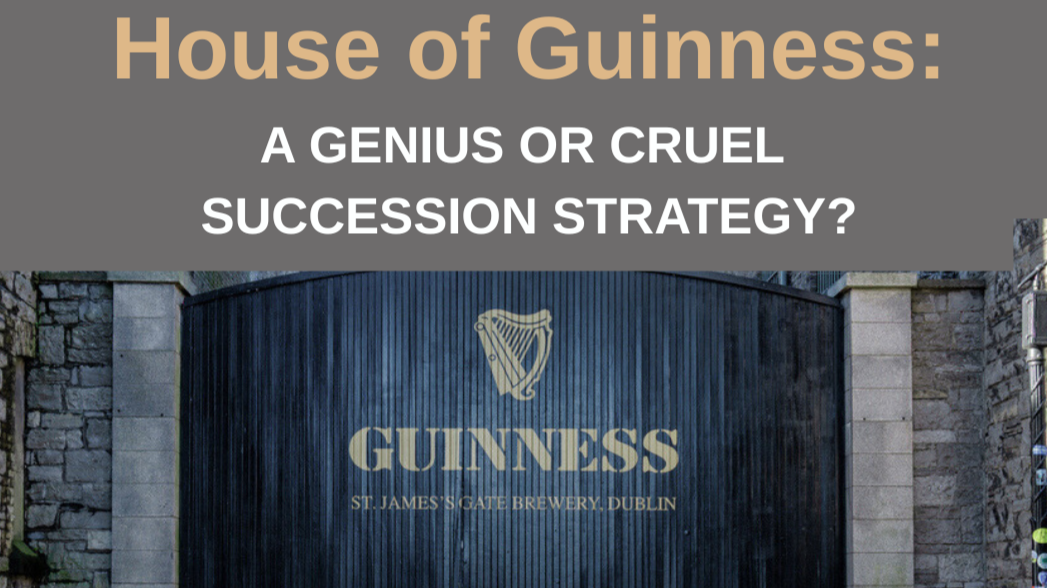
For those of you watching Netflix’s new fictional series The House of Guinness, the patriarch, Sir Benjamin Lee Guinness, who (spoiler alert) passes away at the beginning, adopts an arguably brutal succession strategy. Rather than favouring one heir, he ties the two eldest sons into an ownership structure that satisfies neither party. It’s debatable whether this was brilliant or cruel, binding two very distinct personalities with deep-rooted ideological differences to the business, while ensuring their fates remain inexorably linked to it.
For those of you watching Netflix’s new fictional series The House of Guinness, the patriarch, Sir Benjamin Lee Guinness, who (spoiler alert) passes away at the beginning, adopts an arguably brutal succession strategy. Rather than favouring one heir, he ties the two eldest sons into an ownership structure that satisfies neither party. It’s debatable whether this was brilliant or cruel, binding two very distinct personalities with deep-rooted ideological differences to the business, while ensuring their fates remain inexorably linked to it.
Succession and Exit Planning in the Real World
At Morphose Capital Partners, our core practice is advising and supporting businesses considering an Exit strategy in one form or another and possibly helping raise capital along that journey. This includes, on occasion, advisory on succession planning, and to be clear, putting such a brutal strategy as Sir Benjamin into play wouldn’t top the list. Nonetheless, succession planning does raise serious and often conflicted questions around balancing loyalty, capability, and not least expectations!!
When Family Isn’t the Future
So while idealistically the desire might be for the family to remain custodians of the business, the reality is often that there is no obvious or capable successor to take on the business within the family. Succession planning also comes into play if you’re an owner manager and want a clean break from the business when it’s sold. You’ll never maximise the value if you haven’t got a capable senior manager to step into your shoes and provide continuity and client confidence … even if that isn’t a family member.
Stepping Away, but Staying Invested
If you’re looking to retain a degree of ownership but step away from running the business, it may require looking outside the family to appoint a successor, or management team, most likely already successfully operating the business. However, identifying the right individual or teams, with indelible loyalty to the business and its long-term success, committed to preserving its values over short-term personal gains, and capable of leading it forward, can be elusive. Moreover, they need to be incentivised by having “skin in the game” and if they are to buy that equity then valuations need to be agreed, and debt structured in a serviceable way that satisfies the lenders, those buying into the business, and not least the exiting parties.
Exploring Alternative Exit Structures
In the absence of an executable “family” succession strategy, alternative exit structures must be explored, and the real business and exit priorities identified. These discussions are by no means straightforward, particularly if a business owner has dedicated the best part of their professional life to developing it, and quite likely in adverse times, has risked their personal wealth and may be even relationships to save it. There is always an eagerness to protect their hard earned legacy whenever possible which in turn may shape the type of buyer being sought.
Preserving Integrity vs. Maximising Value
At the heart, is whether the desire is to preserve the integrity of the business, its brand, culture and people, anticipating that future wealth will continue to be generated through the business, or whether the priority is to extract maximum capital at that point in time to secure and preserve personal and generational wealth.
What Does “Good” Looks Like?
These aren’t easy decisions, nor are they necessarily static. They take time to evolve and are swayed by circumstances, market conditions and the business maturity. We ensure that all feasible options are robustly analysed, presented and explained, with up and downsides financially modelled. It’s our business to anticipate and forecast all the variables, then balance and optimise them to achieve the very best outcome for our clients. There is one simple question that all business owners need to ask themselves when contemplating a sale .. “what does “Good” look like to them”? … and if there are several stakeholders it can clearly mean different things to each. The challenge is to identify what’s crucial to each stakeholder so that we can shape the process to meet those needs whenever possible.
What are the Odds?
So while one cannot help but revere the longevity and enduring distinction of the Guinness brand that nearly three centuries on still carries the livery of the founding family. One has to wonder if putting the business before the family really pays off in the long run, because after all, what are the real odds of this outcome being repeated..……
Recent Articles
No recent articles found.